Bone-On-Bone Knees: It’s Not How Worn Your Cartilage Is. It’s Something Most Doctors Never Check.

Four things were supposed to fix my knee.
Supplements. Pills. Injections. And when none of those worked — surgery.
I spent thirty years on the first three. The fourth one ended up on my calendar.
Every year, more than 790,000 Americans sit through the same conversation I did — your cartilage is gone, your only real option is a total knee replacement.
I'm 63. I had 30 years of bone-on-bone arthritis in my right knee, a total knee replacement scheduled, and a bottle of Ibuprofen in every room of my house.
I don't have any of those things anymore.
And here's the part that still makes me angry, three decades later:
Not one of those four things was ever aimed at why the joint was failing.
Every one of them was working on something else — the pain, the swelling, the symptom, or the joint itself once it was already gone. Not the reason.
Let me show you what each one actually bought me. Then I'll show you the thing I found on the fourth try, an hour into reading on my laptop at eleven at night, that explained all four failures at once.
The deal I'd made with my knee
For 28 of those 30 years, I kept using that knee anyway.
Running, in my case. I'd been a runner my whole adult life and I wasn't willing to give it up, so I took something for the pain and went out anyway.
Four Ibuprofen before a Sunday morning run. That was the deal I'd made with myself — take something, keep going, deal with it later.
I don't think that makes me unusual. Every person I know with a bad knee has some version of that deal. The job that doesn't stop. The stairs at home. The grandkids who want picking up and don't care what your knee has to say about it.
My deal held for 28 years.
Then, about a year before any of this, my body stopped honoring it.
I couldn't run.
I tried anyway, a few times. Made it a couple of blocks and paid for it for the next three days.
And once I stopped, I did every single thing I was supposed to do. I went to the doctors. I followed the plan. I took what they gave me. I did the exercises.
The joint got worse anyway, year after year.
That's the part I still can't get past.
Not the 28 years of pushing through it. The two years I did everything I was told — while the last of the cushion in that knee wore down to nothing.
Because that's what bone-on-bone actually is. Not a diagnosis. Not a phrase on a chart.
It's the end of the femur and the top of the shin with nothing left between them.
You can hear it when it gets that far. Standing up out of a chair sounds like something dragging. Bending it makes a sound my wife could hear from the next room.
And you feel every bit of it — a deep, grinding scrape that goes straight up through the leg, and a hot ache afterward that sits there for hours.
Two years of doing everything right, and that is what I ended up with.
What each of those four things actually bought me
1. The supplements
Glucosamine and chondroitin, mostly. Bottle after bottle, year after year.
If you've ever stood in that aisle you know why — they're in nearly everything on the shelf. I bought the store brand. Then the expensive one. Then the one with the smiling couple hiking on the label.
When those did nothing I moved on to whatever was next to them. Turmeric. MSM. CBD oil.
Nothing. Worked.
By the end my wife had stopped asking what the newest bottle was. I don't blame her for that. She'd watched every single one of them fail, and she'd watched me keep buying them anyway.
And here's what I didn't find out until much later.
In 2016, Harvard Medical School published a review on glucosamine and chondroitin — the two ingredients I'd spent most of a decade swallowing, and the two in nearly every joint bottle sold in this country.
Their conclusion: these supplements offer "little to no benefit" for most arthritis patients.†5
Americans spend over $1.6 billion a year on them anyway.
Those formulas haven't meaningfully changed in 30 years. Not because they work — because they're cheap to make and easy to mark up.
I'd been buying the same two ingredients, in different bottles, for most of three decades.
2. The pills
Ibuprofen and Celebrex, like candy. Some days a dozen pills just to get through the morning. Four every Sunday before I could get out the front door.
They worked, in the sense that I could feel less. They did nothing at all to the joint.
The FDA strengthened its warning that non-aspirin NSAIDs — Ibuprofen, Celebrex, Naproxen — increase the risk of heart attack and stroke, even with short-term use.†1
Worse: the research suggests NSAIDs may actually accelerate cartilage breakdown over time.†2
I was taking up to 12 pills a day for years. No doctor ever mentioned either of these things to me.
So that one wasn't neutral either. It masked the pain, raised my heart attack risk, and may have been chewing through the very cartilage I was trying to save.
3. The injections
Three of them, straight into the joint. Two months, then one month, then two days.
That's not a treatment getting less effective. That's a treatment that was never touching the problem in the first place — it was renting me time, and the rent kept going up.
4. The surgery
Which is how a total knee replacement ended up on my calendar. Not because anyone thought it would make me young again. Because the first three had failed and it was what was left.
I want you to sit with that sequence for a second, because it's the whole point.
Four things. Not one of them was aimed at why the joint was failing. Three managed the pain and one removed the joint.
Nobody ever stopped and asked why nothing was reaching it.
- You've been told bone-on-bone — or been told you're heading there
- You grip the railing on every staircase — going down worse than going up
- You can hear it — the grinding or the click when the joint bends
- Mornings take a while — the knee needs time before it will cooperate
- You plan the day around the walking — how far, how many stairs, where you can sit
- You take NSAIDs most days — not for flare-ups, just to function
- The injections stopped lasting — each round buying less time than the one before
- It swells after you've been on your feet — worse at night than in the morning
- Someone has said "knee replacement" to you — and you haven't stopped thinking about it
- You've already tried glucosamine — and it did nothing at all
If three or more of those are you, the rest of this is worth your ten minutes. Because every one of them was me.
Then a passenger got into my car
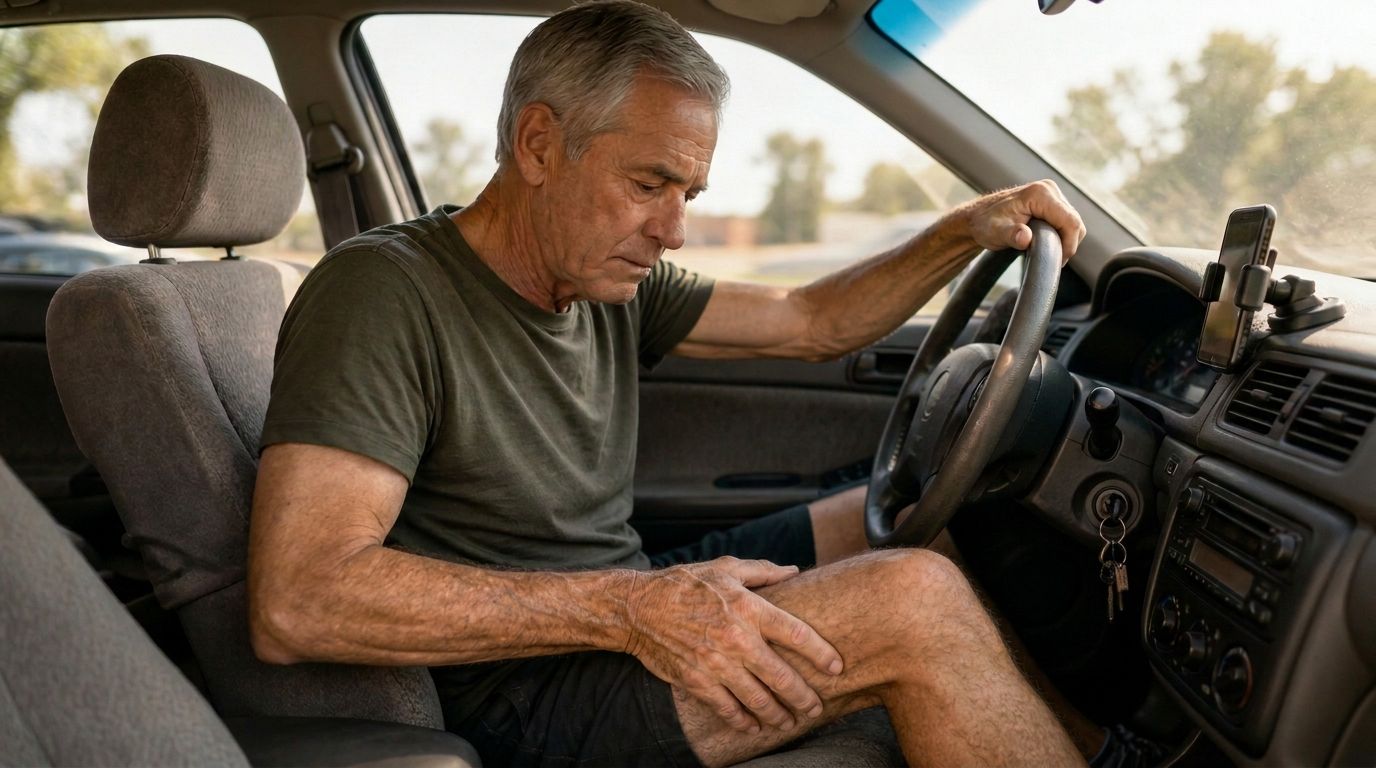
One afternoon a woman climbed into my back seat for a ride into the city.
She noticed me wincing as I shifted in my seat and asked if I was okay. I gave her the answer I'd given a thousand people. Old knee injury. Bone-on-bone. Surgery's already scheduled.
Then she said something I wasn't expecting.
She told me she had something that had worked for people exactly like me. It came from an Ayurvedic herbalist in India — a man who had spent 40 years in clinical practice building blends for joint problems like mine.
I'd heard versions of this pitch before. Everybody's got a miracle.
Then she told me the part that made me actually listen.
The only reason this formula was available in the United States at all was that one of his blends had saved her own life years earlier. She wasn't a supplement seller. She was someone who'd been helped, and she'd started a company because she wanted other people to be able to get it.
She wrote a website on the back of a receipt and slid it across the seat.
"Try it for 90 days," she said. "If it doesn't work, you get every penny back."
I almost threw the receipt away. I'd wasted years and a small fortune on supplements that did nothing, and every one of them had a story attached.
My wife didn't think it would work either
When I told her I'd ordered it, she didn't say much.
I want to be fair to her here, because she'd earned that silence.
She'd watched me carry home bottle after bottle for years. The CBD. The glucosamine. The turmeric. She'd watched every one of them do nothing, and she'd watched me get quieter about it each time.
She'd also watched the rest of it. She was the one standing at the bottom of the stairs. She was the one who stopped suggesting we walk anywhere. She'd been living next to that knee just as long as I had, only she had to watch it instead of feel it, and I'm not sure which of those is worse.
So when I came home talking about a herbalist in India and a website written on the back of a receipt, she didn't roll her eyes and she didn't argue.
She just didn't believe it.
And based on everything she had seen, she was right not to. If I'd been standing where she was standing, I'd have thought exactly the same thing.
But that night I started reading. Not the sales page — the actual science. And about an hour in, I found the thing that explained all four failures at once.
Your cartilage has no blood supply. Nothing you swallow reaches it directly.
Almost every tissue in your body is fed by blood. You swallow a nutrient, it enters your bloodstream, your blood delivers it. Simple.
Cartilage is different. Cartilage has no blood vessels in it at all.
Not a few. Zero.
So how does it eat?
It's fed entirely by a thick fluid inside the joint capsule called synovial fluid. Every time you bend the joint, the cartilage compresses like a sponge and squeezes fluid out. Every time you straighten it, the sponge expands and pulls fresh fluid — with nutrients in it — back in.
That squeeze-and-soak cycle is the only delivery route your cartilage has.
"The way you get nutrients to cartilage is through movement."
Kraus is one of a small number of researchers who study how this tissue turns over. She points out that adult cartilage has no blood supply at all, and depends instead on loading the joint to move nutrient-carrying fluid in and out.
Now here's what goes wrong.
When a joint becomes chronically inflamed, that fluid changes. It thins. It loses the qualities that let it carry and deliver. And the inflamed joint lining stops being a clean filter.
So the delivery system itself breaks down.
I call it the synovial block.
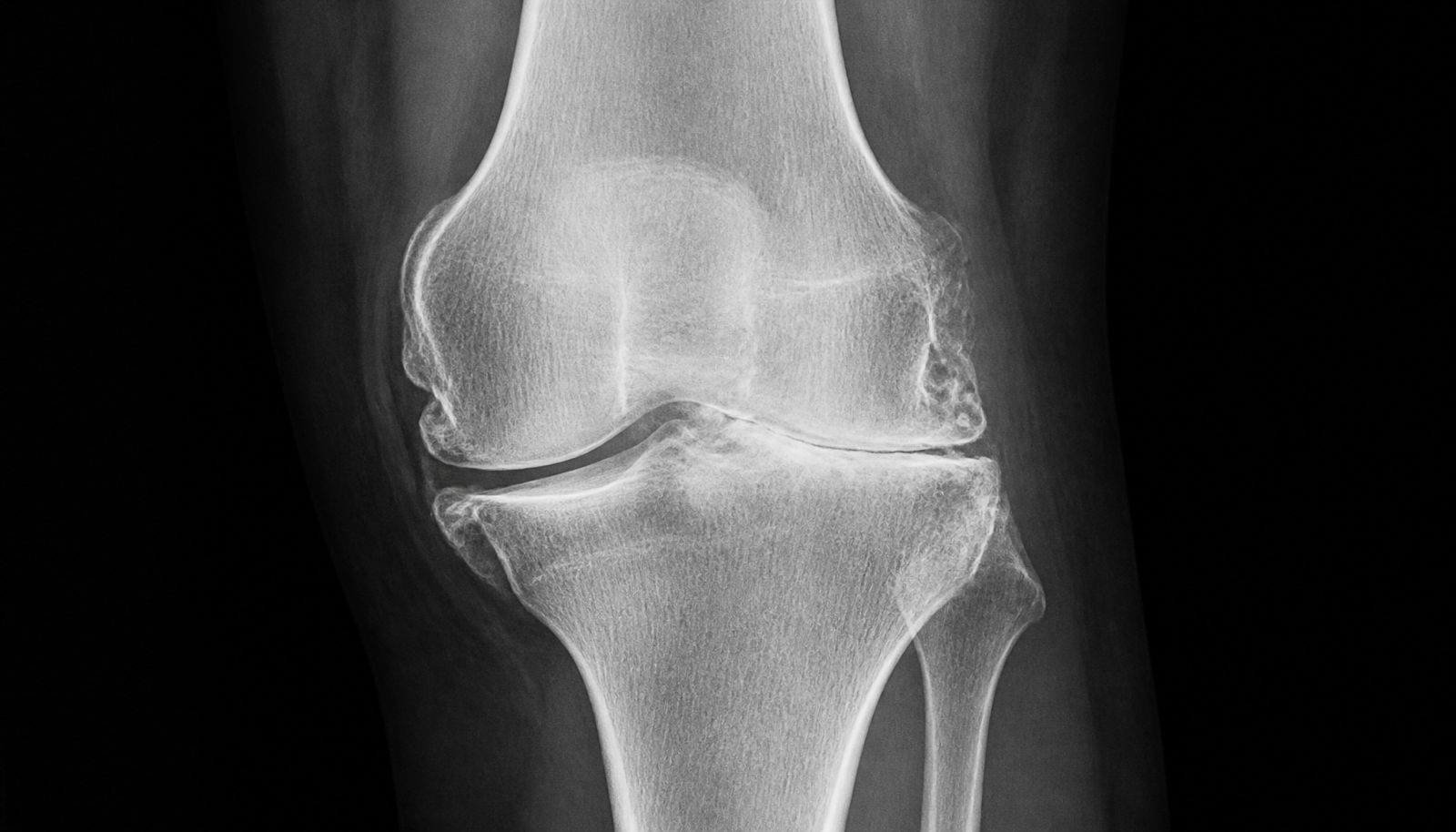
Go back and look at my four things with that in your head.
The pills didn't reach the cartilage — they worked on how I felt. The injections went into the capsule but did nothing about why the fluid had stopped delivering. The supplements got into my bloodstream just fine, then hit a wall at a joint that couldn't take delivery. And the surgery wasn't a treatment at all. It was what you do when the tissue is gone.
It was never the supplement. It was never the effort. It was the delivery.
And that's the thing about glucosamine and chondroitin specifically. They aren't nonsense. They are cartilage building blocks — that's the whole theory. Supply the raw material, the body rebuilds the cushion.
It's a reasonable idea. It's just aimed at the wrong problem.
The raw material was never what was missing. The delivery was.
Thirty years of handing cartilage a nutrient, and not one of those bottles was built to open the door first.
That's why my three decades didn't matter. I was mailing packages to an address that was blocked off.
Why there is no "active ingredient" in this formula
The thing on that receipt is called MyVada Joint Plus.
I'd never heard of it. Neither had my doctor, when I asked him later.
And when I finally read what was actually in it, it took me a while to understand what I was looking at — because it isn't built the way anything else in my cupboard was built.
Here is where the American supplement aisle and Ayurveda part ways completely.
Western formulation looks for the one active compound. Isolate it, concentrate it, put it on the label in bold. That's why every joint bottle on the shelf is built on one or two ingredients — and why they all look the same.
Ayurvedic formulation has no hero.
That isn't a marketing position, it's the entire principle. Herbs are chosen to carry each other. Some open the tissue. Some deliver. Some hold the effect in place so it doesn't wash straight out. Some are in there only to make the others tolerable to the body over months of daily use.
Pull one out and the rest stop working the way they were meant to.
So when I tell you what's in it, I'm not naming the star. There isn't one.
Calming the joint lining
Nothing else in the formula gets to do its job while the joint is inflamed — that's the synovial block.
Several herbs in the blend work on this together, and yes, one of them is Indian Frankincense. You'll find boswellia in plenty of bottles now; it turned up in the American market about a decade ago and got treated the way this industry treats everything — isolate it, concentrate it, sell it alone.
On its own it is one compound doing one job. Here it sits inside 38 other herbs that were chosen, over forty years, specifically to work alongside it.
That's not the same product. It isn't close.
Clearing what's settled in the tissue
In Ayurveda the accumulated residue that gathers in joints has a name: ama. Clearing it is a distinct job, handled by a distinct group of herbs — Guggulu among them, the resin the tradition reaches for when something is stuck and needs moving.
Modern life didn't reduce that load. It multiplied it. We're exposed to thousands of compounds our joints were never built to filter, and some of them settle in and speed up the breakdown.
The other thirty-seven
I thought I was buying two or three actives with filler around them, the way American supplements are built.
I wasn't. There are 39 herbs in this formula. All organic. All doing something.
Most of them don't even have English names. Rasnamu. Heart Leaf Moon Seed. Himalayan Cedar. Krishnajeeraka. Vidanga. Some have been used in India for centuries. Some are still being studied.
Which is the point, when you think about it. Everything I'd already tried came from the same short list of ingredients. Doesn't it make sense that the answer might be something I'd never taken in my life?
And what it does not contain matters just as much: no glucosamine, no shellfish, no fillers, no binders, no synthetics.
Hand-picked from small family farms in India. Naturally sun-dried for six weeks. Blended in an FDA-registered, GMP-certified facility.
(Current availability and pricing are here.)
What actually happened, day by day
I didn't order it with confidence. I ordered it because I had a surgery date and nothing left to lose but another month.
One capsule twice a day. Empty stomach, at least 30 minutes before food. Morning and night, no skipped days.
MyVada Joint PlusHonestly? Not much. Some mornings felt looser. I told myself it was the weather.
I put my socks on. Standing up. Without thinking about it. I got halfway to the kitchen before I realized what had just happened and stopped in the hallway.
I climbed the stairs at my front door and didn't grip the railing. I hadn't done that in over a year. I went back down and did it again just to see if it was a fluke.
I went for a run.
Just the neighborhood loop I used to use as a warm-up. Nothing heroic.
I came home tired. The next morning I was sore — but it was the normal kind of sore. The kind any runner feels after a first run back.
Not the deep grinding scrape that had been my whole life for three decades.
A few days after that, I called the surgeon's office and cancelled the knee replacement.
(MyVada Joint Plus is sold direct rather than in stores — current availability and pricing are here.)
I did the loop twice. Then I started adding to it.
The thing I noticed most wasn't the running — it was that I'd stopped planning my day around how much walking was in it.
Stairs stopped being a thing I thought about at all. Not "easier." Just gone from my head, the way they are for someone who's never had a bad knee.
Three months in. Not one, not two. If I had stopped when the first bottle ran out I would never have got here.
I wasn't managing a knee anymore. I was just a guy who runs.
And the mornings that used to start with four Ibuprofen started with coffee instead.
I'm 63. I run half marathons.
I've never rescheduled that surgery.
I don't know whether I was typical. I suspect I wasn't.
Look back at my own first two weeks — nothing. If I'd judged this at the end of one bottle, I'd have been judging it before the part that actually mattered had even started.
My knee took 30 years to get that bad. Thirty days was never going to be a fair test of it.
MyVada says 60 to 90 days, and that matches what I lived. The early stuff came first. The changes worth having came later.
So if you try it, give it the three months. That's the only advice I've got that I'd stand behind — and it's why the guarantee runs 90 days and covers empty bottles.
(See what MyVada Joint Plus costs and whether it’s in stock.)
I'm not the only one
I know how this sounds. Some guy on the internet says he cancelled his surgery.
So after my own results, I went and read what other people were saying. There are 164 verified buyer reviews on the product page. I wasn't an outlier.
"I didn't think this would really help bone on bone. I mean, they said it can thicken cartilage, but what can you do if there's NO cartilage on your bones to actually get thicker? That's what my doctor told me — no cartilage left, and the only option was surgery. Well… here I am 8 months after starting MyVada and it's as though my joints are like new again. And I was a severe case of bone on bone."
"I have bone-on-bone for both knees & have tried numerous products & procedures to avoid surgery. This is the only product that fulfills its promise. Can't remember the last time I took Tylenol for pain."
"Both of my knees are bone on bone. It hurt just to stand up from a chair and steps were difficult. After only a week of taking MyVada the pain is fading away. I've been taking it a couple of months now and my knees feel great and are pretty much pain free."
"After years of enduring bone on bone in my left knee, I almost lost hope. I had even considered getting a knee replacement — but I'm happy to report after 6 months of taking MyVada, my doctor said I don't need one!"
"I've had bone on bone in one of my knees for over 10 years and MyVada has completely changed my life. I've been taking it for 4 months. I'm not 100% pain free, but it does work really well, certainly better than anything else I've tried."
"I'm a retired veteran, and the bone on bone pain in my knees was a constant reminder of my service. MyVada Joint Plus has brought relief and eased the discomfort, allowing me to enjoy my retirement."
Why I tell everyone 90 days, not 30
Here's something I learned the hard way.
My cartilage didn't wear away in 30 days. It can't come back in 30 days either.
I noticed real changes in the first 15 to 30 days — less pain, more flex, stairs stopped being an event.
But the deeper work — the inflammation coming down across the whole system, the joint clearing out, the cartilage getting support to thicken — that took 60 to 90 days of consistent twice-daily use.
That's exactly why MyVada offers a full 90-day money-back guarantee — even on empty bottles. They want you to have enough runway for the formula to actually do its job.
It's also why most people order the multi-bottle pack the first time. It's the honest amount of time.
The part I need you to understand
Cartilage does not sit still and wait for you.
Once a joint is chronically inflamed, the loss compounds. Every month you spend inside the synovial block is a month of tissue you don't get back — and the further it goes, the less there is left to work with.
Right now, if you're dealing with grinding, stiffness, stairs, swelling, morning pain — you still have something to save.
If you wait a year? There's less. And the conversations change. They stop being about pain and start being about surgery dates and recovery timelines and who's going to drive you home.
I know, because I had those conversations. I had the date on my calendar.
So if any of this is you:
- Bone-on-bone, or been told you're heading there
- Gripping the railing on every staircase
- Grinding or clicking you can hear
- Taking NSAIDs most days just to function
- Injections that work for less time every round
- Your doctor has said the words "knee replacement"
- You've already tried glucosamine and it did nothing
This is the moment.
MyVada Joint PlusNot after the surgery is scheduled. Not after they take the joint out.
Now — while there's still something in there worth protecting.
MyVada Is Giving New Customers Up To 47% Off — While Stocks Last

Free shipping on every order. No subscription, no strings attached.
Why I'm telling you this
I'm a 63-year-old Uber driver from Colorado. I'm not paid to write this and I don't work for MyVada.
I'm writing it because for 30 years I lived with a joint that was destroying itself while I did everything I was told to do.
30 years of running on pain I had no business running on. 30 years of NSAIDs that may have been making the damage worse. 30 years of nobody ever telling me why none of it worked.
If a stranger hadn't gotten into my back seat that afternoon, I'd be recovering from a knee replacement right now. Or living with the one they gave me.
My wife orders it now. She didn't believe in it either — she had thirty years of good reasons not to. She just believes what she sees.
Instead I'm 63 and I run half marathons.
And my wife — who didn't believe a word of it, and had every reason not to — is the one who reminds me to take it.
Not to prove anything. Just because I can. Just because I get to.
If your doctor has said the words "knee replacement" — you owe yourself 90 days before you let anyone open that joint.
There's a guarantee. Even on empty bottles. Even if you hate it.
You have nothing to lose except the thing that's been taking your life away one step at a time.
Wishing you the same relief I found,
Charles Y.
Colorado
Charles is 63 and lives in Colorado, where he drives for Uber in semi-retirement. He ran for 30 years on a knee that was bone-on-bone for all of them — 28 of those years through the pain — and spent most of that time on daily Ibuprofen and Celebrex. He went through three rounds of synovial fluid injections, tried glucosamine, chondroitin, turmeric and CBD, and had a total knee replacement scheduled before he cancelled it. He has taken MyVada Joint Plus daily since 2022 and now runs half marathons.
This account is published with Charles's written consent. He is a MyVada customer and his results are his own; individual results vary.
Questions people ask
How fast will I see results?
How is this different from glucosamine?
Is it safe with my other medications?
What does the guarantee cover?
How does it ship?
Why is it more expensive than drugstore joint pills?
How do I take it?
Can I get it on Amazon?
Important Disclaimer: This is an advertisement and not an actual news article, blog, or consumer protection update. Customer testimonials are from real, verified customers who have used MyVada Joint Plus, published with their consent. Individual results may vary. Photographs are illustrative and do not depict the individuals described.
These statements have not been evaluated by the Food and Drug Administration. MyVada Joint Plus is not intended to diagnose, treat, cure, or prevent any disease. Not a substitute for professional medical advice, diagnosis or treatment. Always consult your physician before starting any new supplement, especially with a medical condition or prescription medication.
MyVada Inc · 809 W Riordan Rd, Ste 100 PMB 1136, Flagstaff, AZ 86001 · 1-855-305-5249 · support@getmyvada.com
The Mobility Report is published by Meridian Health Daily, an advertising publication operated by MyVada Inc.
Privacy Policy · Terms of Use · Advertising Disclosure · Contact
- †1 FDA — Drug Safety Communication: FDA strengthens warning on non-aspirin NSAIDs
https://www.fda.gov/drugs/drug-safety-and-availability/fda-drug-safety-communication-fda-strengthens-warning-non-aspirin-nonsteroidal-anti-inflammatory - †2 NSAIDs and cartilage breakdown — PMC5567597
https://www.ncbi.nlm.nih.gov/pmc/articles/PMC5567597/ - †3 Boswellia and cartilage support — PMC3644751
https://www.ncbi.nlm.nih.gov/pmc/articles/PMC3644751/ - †4 Arthritis Foundation — Causes of inflammatory joint pain
https://www.arthritis.org/health-wellness/healthy-living/managing-pain/understanding-pain/causes-of-inflammatory-joint-pain - †5 Harvard Health — The latest on glucosamine/chondroitin supplements (2016)
https://www.health.harvard.edu/blog/the-latest-on-glucosaminechondroitin-supplements-2016101710391 - †6 Scientific American (Feb 2024) — Dr. Virginia Kraus, Duke University School of Medicine, on cartilage nutrition via synovial fluid
https://www.scientificamerican.com/article/your-body-may-be-able-to-repair-its-arthritic-joints-with-help-from-drugs-or-surgery/